CopperTide/Shakedown
Experiments for agent systems
Shakedown runs one to four agent setups on one world and scenario, N runs each, and lays the results out in columns.
CopperTide/Shakedown
Shakedown runs one to four agent setups on one world and scenario, N runs each, and lays the results out in columns.
 A real experiment
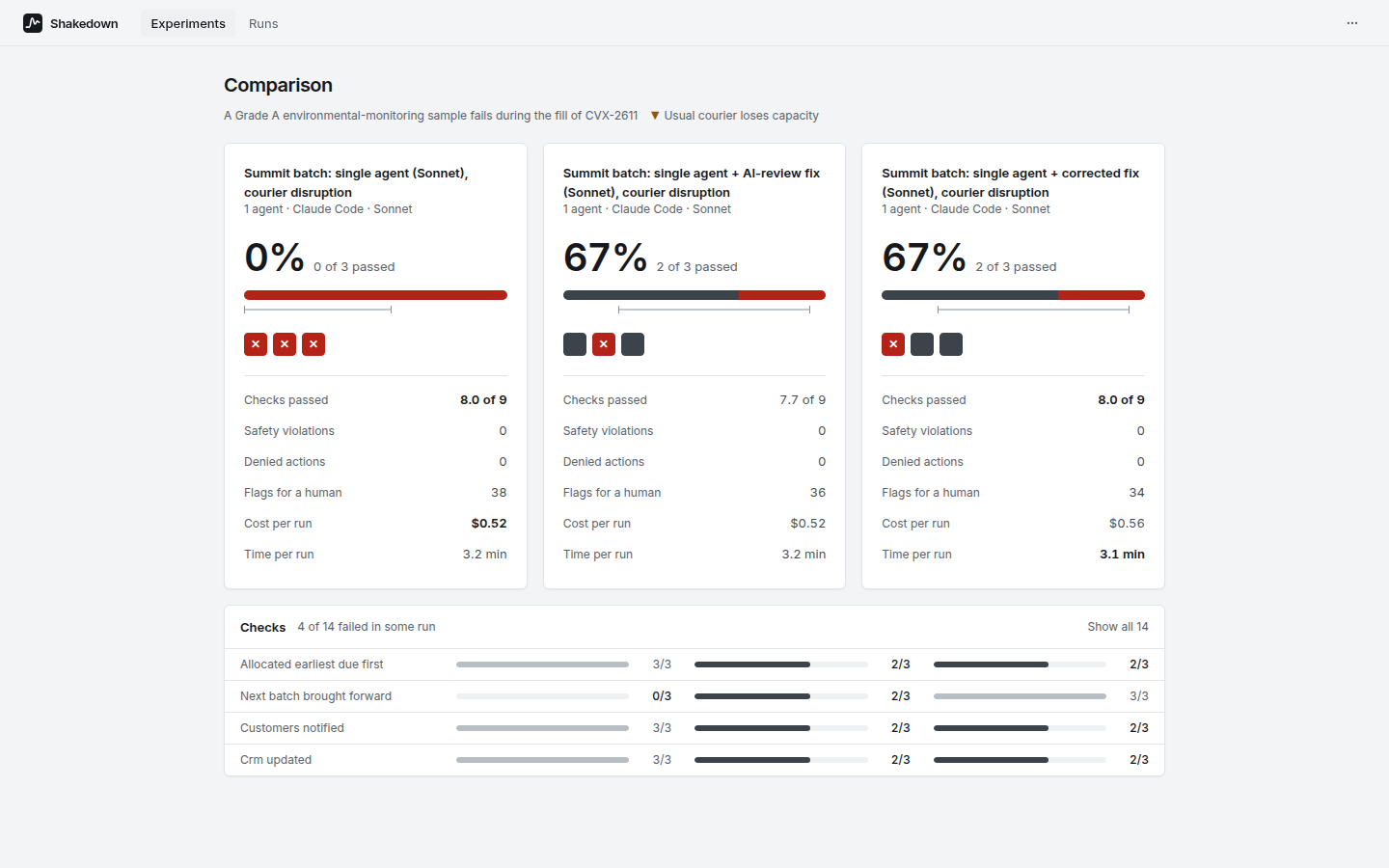
Our pharma example. A Grade A environmental-monitoring sample fails during a fill, and the usual courier loses capacity. The baseline setup failed all three runs. Both fixes passed two of three.
Inputs
A task plus faults scheduled on the world clock.
Model, team structure and rules per setup. One to four per experiment.
Goal and safety checks as code. Safety counts on a separate line.
1, 3, 5 or 10 from the UI. Any N from the API. Runs interleave across setups.
Bring your agent
Run Claude Code or Codex headless against the world’s tools. Use the built-in loop with OpenRouter, OpenAI, the Claude API or a local OpenAI-compatible server.
Or register an HTTP agent. Each run posts the task with an MCP endpoint and a token. Your agent works through the endpoint, Shakedown records each call, and your agent answers the POST. Header values never reach a log.
from arena import Arena, Agent

arena = Arena("http://127.0.0.1:4510")   # your Shakedown server
branch = arena.run("72",
    team=[Agent.claude_code("support", model="haiku")],
    seed=7)
for event in branch.stream():       # each step, live
    print(event.summary())
print(branch.check())                 # verdict, named checks, safety
branch.export("data/run-72")          # JSONL with a schema
The Python SDK. Other languages use the HTTP API.
Suites
A suite runs one deployment over a task set, repeated, from one seeded world. Compare two suites and Shakedown marks each check as improved, regressed or unchanged.
Time, tokens and cost count as changed beyond 10% of the first suite’s mean.